Arts & literature · Autograph & handwriting
William Shakespeare signature
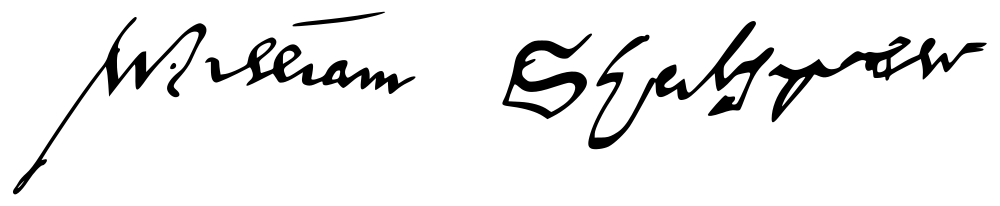
Two slender word groups form this Shakespeare specimen.
What does William Shakespeare’s signature look like?
Two slender word groups form this Shakespeare specimen. A long descending tail appears at the far left, and an upper stroke stretches over part of the first name.
- Slant
- +34°forward
- Baseline
- +1.1°near level
- Width / height
- 5.36 : 1overall proportions
- Opening height
- 1.69×opening versus body letters
Fine cursive with an opening descending tail
Two slender word groups form this Shakespeare specimen. A long descending tail appears at the far left, and an upper stroke stretches over part of the first name. The surname’s more angular opening gives way to small joined forms; compare that change of direction with the thin connecting lines that keep the full name narrow.
William Shakespeare signature analysis
William Shakespeare’s signature sample has 34° of forward slant, a near-level baseline and 6 enclosed loops. Use the layers to follow the writing line, letter band, slant and enclosed loops.
- Slantforward
- +34°
- Baselinenear level
- +1.1°
- Width / heightoverall proportions
- 5.36 : 1
- Opening heightopening versus body letters
- 1.69×
- Enclosed loopsclosed spaces in the image
- 6
- Ink groupsmain disconnected groups
- 6
- Ink densityinside the signature bounds
- 8.4%
- Underlineno long lower flourish
- None
- Finish heightrelative to the letter body
- +0.53×
Opening, letter body and finish
The opening stays near the height of the body letters. The opening-to-body ratio is 1.69×, while the whole image is 5.36 times as wide as it is tall. The rightmost ink finishes above the writing line; look at this ending separately from the slant of the letters themselves.
Loops and the lower flourish
The sample contains 6 enclosed loops and 6 main ink groups. The letterforms carry the main horizontal movement; there is no long lower underline detected beneath their band.
William Shakespeare’s signature in graphology
Traditional graphology associates fine connected writing with a flowing, economical presentation. The descending opening and angular surname capital add individual emphasis without a broad decorative frame around the complete name.
Follow the forward-leaning strokes in this image alongside the smaller body letters. For another perspective on your own writing, the handwriting analysis tool brings slant, size and spacing into a full-page reading.
Signatures with similar shapes
Compare these samples’ slant, proportions and letter rhythm with William Shakespeare’s autograph.