Slant
+11°Angle of the letter strokes from vertical. Positive angles lean right; negative angles lean left.
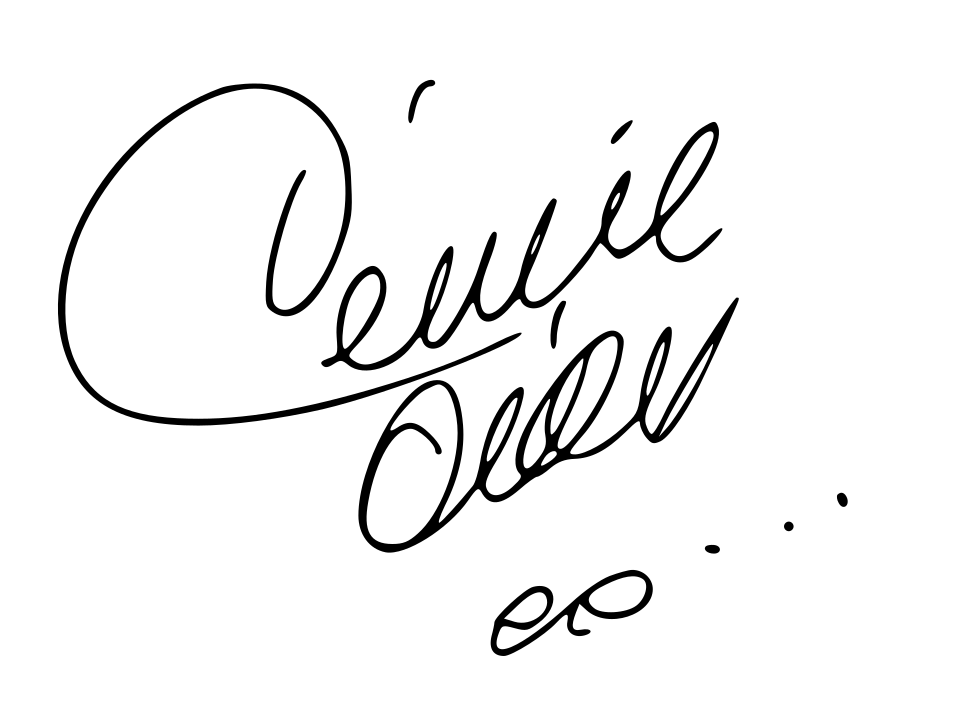
The signature has a forward slant (+11°). The blue-green guides show the lean of strokes across the name.
SIGNATURE ANALYZER
Draw or upload your signature to inspect its slant, capital emphasis, loops, underline and finish, with its graphology reading and closest signature shapes.
Dark ink on a light background · PNG, JPEG or WebP · up to 25 MB. Drop or paste an image with Ctrl+V (⌘V on Mac).
EXAMPLE ANALYSIS
Michael Jackson’s signature
Angle of the letter strokes from vertical. Positive angles lean right; negative angles lean left.
The signature has a forward slant (+11°). The blue-green guides show the lean of strokes across the name.
Direction of the writing line from the beginning to the end of the signature.
The writing line falls (−2.2°). The red guide follows the base of the letters, separate from lower loops and flourishes.
Height of the opening letter relative to the typical letters that follow. 1× means similar heights.
The opening stands 2.1 times as high as the following letters. The purple box marks its area; the dashed blue guide marks the letter-body band.
Closed spaces surrounded by ink, counted across the whole signature.
There are 7 enclosed loops in the sample. Orange outlines locate them. Compare their size and placement within the name.
Separate connected areas of ink in the image. Dots or detached letters can form additional groups.
The signature contains 1 main ink group. Most of the visible ink joins into one connected shape. Look at where those shapes join or separate.
Share of the signature’s enclosing rectangle occupied by ink.
Ink covers 4% of the measured signature area; the rest is open space. This describes how filled the shape is, rather than how hard the pen pressed.
Length of a lower underline or flourish compared with the full signature width.
No long lower underline is detected. The name is carried by the letterforms and their own lower strokes.
Height of the rightmost ending above or below the baseline, in typical letter heights. Positive is above; negative is below.
The ending sits close to the writing line (−0.4 letter heights). The orange guide locates the finish relative to the red baseline.
Full ink width divided by full ink height, including the signature’s tall and low strokes.
The shape is 1.0 times as wide as it is high. Its ink spans 303 × 298 image pixels. Compare the horizontal spread with the vertical reach of the capitals and loops.
Total traced stroke length divided by signature width. More turns and retraced shapes add length.
The traced strokes total 2,063 pixels, about 6.8 times the signature’s width. Look for loops, turns and flourishes that add movement within that width.
Number of corners per 100 pixels of traced ink outline. Higher values indicate more frequent sharp turns.
The outline contains about 4.4 corners per 100 pixels. Inspect the turns in the pen-path layer and compare pointed changes of direction with rounded curves.
The signature has a forward slant (+11°). The writing line falls (−2.2°). The opening stands 2.1 times as high as the following letters. The ending sits close to the writing line (−0.4 letter heights).
A forward lean is traditionally read as responsiveness and enthusiasm: movement toward people and goals.
A falling line is traditionally linked with reduced energy at the moment of signing.
The opening introduces the name; its shape and proportion set the first visual emphasis.
Without a separate lower underline, the signature places its emphasis in the letters themselves.
The finish stays near the line, closing the name within its main writing band.
An elaborate stroke path is traditionally read as flair and expressive presentation.
Compare the measured slant, proportions and stroke shapes.
The opening capital gives the name its first emphasis. The smaller letter bodies establish its rhythm, while loops, an underline and the finishing stroke shape the overall silhouette. Read each part alongside the whole name.
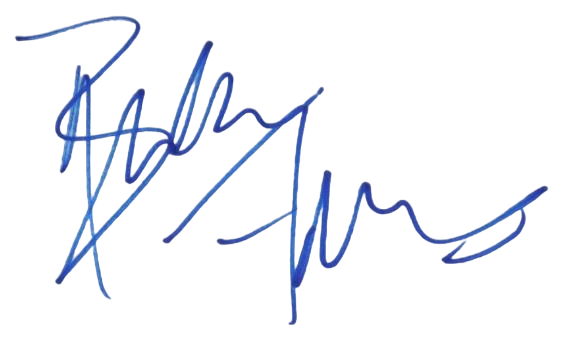
Compare a signature with an ordinary note using the handwriting analyzer, then look at the two samples’ shared and contrasting features.